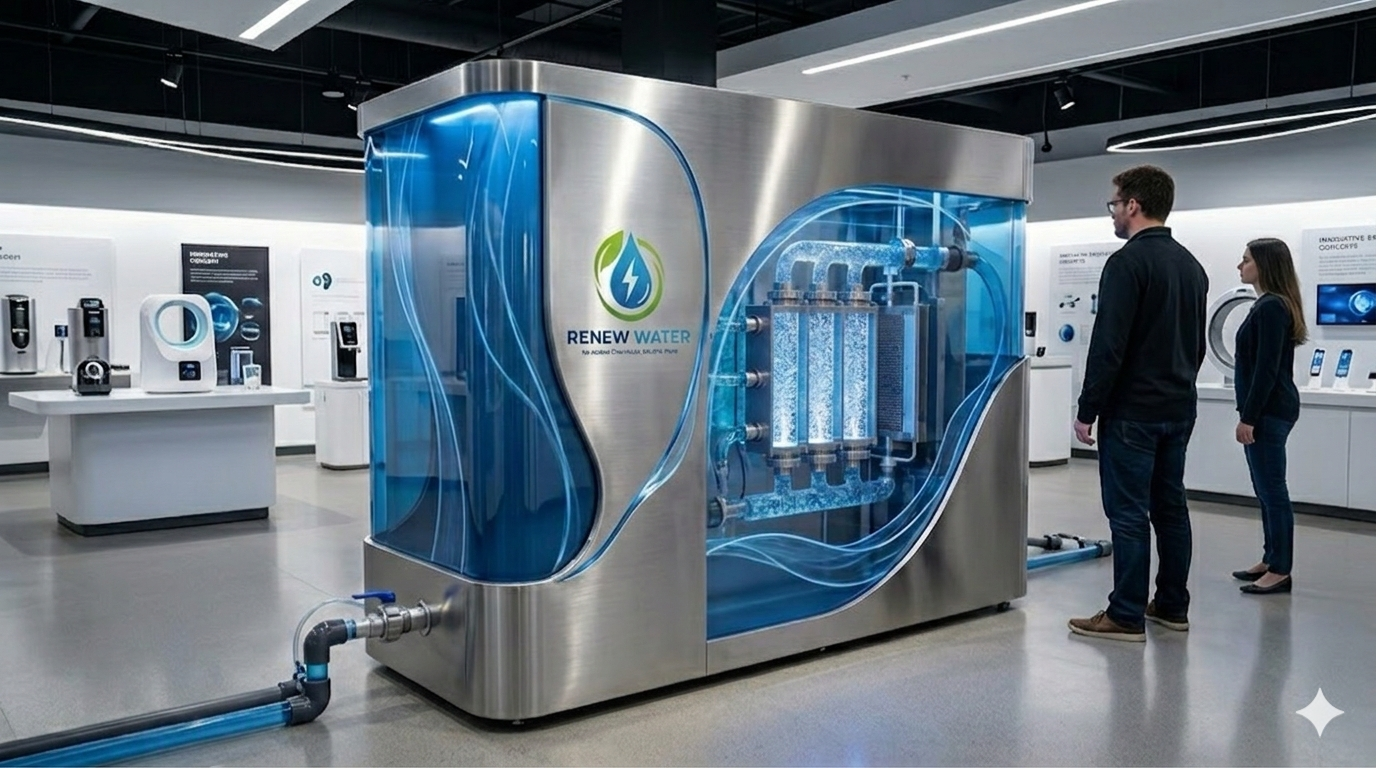
Our technology - CavOx
CavOx, Renew Water's core treatment technology, was initially developed in Africa to address the challenges in obtaining clean drinking water. After developing a unique electrocavitation method, the original technology was deployed into multiple commercial and trial sites across food and beverage production, pharmaceutical manufacturing, and municipal wastewater treatment sites. These operating plants showcased the potential of electrochemical methods to purify water without chemical inputs and certified to recognized potable and process standards.
The unique electronic configuration of the CavOX system significantly reduces the main obstacle of well-established cavitation and oxidation techniques: High electricity costs. A redesigned non-sacrificial cathode substantially extended operational life between service intervals, removing the maintenance overhead that had previously constrained commercial scaling. CavOx represents the cutting edge of electrochemical cavitation combined with a non-sacrificial electrode that allows low energy, zero chemical water purification. Renew Water was formed to bring this next-generation design to the market. Our first product, RenewPool, is currently being certified to UL standards and we are actively building pilot partnerships across multiple verticals.
CavOx Technology
CavOx combines three simultaneous treatment steps (electrocoagulation, electrochemical oxidation, and hydrodynamic cavitation) in a single pass. It is designed for difficult to treat, high-turbidity and high-organic-load conditions where UV and chlorine each have well-documented limitations.
An electrical current causes suspended solids and colloids to bind and settle. CavOx handles turbidity and particles first including in water that would block UV treatment entirely.
Reactive oxygen species (hydroxyls) are produced directly by CavOx within the water. These attack pathogens and organic compounds without adding any chemical reagents to the water stream.
Pressure changes create and collapse microscopic bubbles throughout the fluid. The high-energy release physically disrupts microbial cells (including crustaceans), amplifies the oxidation effect and creates an oxidation re-agent directly from the water.
Technology comparison
A detailed comparison of CavOx against UV irradiation and chlorination across economics, pathogen performance, and operational characteristics — based on independently verified field data.
The critical difference: UV inactivates pathogens at the point of contact but provides zero downstream protection — pathogens can re-establish in distribution networks, especially when exposed to sunlight. CavOx generates a highly oxidative residual that, similar to chlorine, continues disinfecting for several days after delivery, without adding any chemicals.
| Metric | UV Irradiation | Chlorine (Gas or Sodium Hypochlorite) | CavOx |
|---|---|---|---|
| ▾Economics | |||
| CAPEX | $200,000 – $400,000+ / M Gal / DayHighly dependent on target log-reduction and reactor redundancy | $80,000 – $240,000+ / M Gal / DayIncludes contact basins and automated dosing skids | $300,000 – $500,000 / M Gal / DayDepending on influent water quality |
| OPEX | $60 – $130 / M GalDriven by electricity consumption and lamp life | $30 – $80 / M GalDriven by chemical consumption and safety monitoring | $12 – $25 / M GalDepending on influent water quality |
| Energy | 60 – 160 kWh /M GalMedium pressure lamps consume more but treat faster | <8 kWh /M GalPrimarily for small dosing pumps and sensors | 70 - 100 kWh /M GalComparable to UV; no chemical energy penalty |
| Parts life | Yearly lamp replacement5 – 8 years for ballasts; failed lamp = immediate capacity loss | 10+ years (tanks)3 – 5 years for pump seals and diaphragms | 10+ yearsSystems operating 8+ years with zero electrode degradation |
| Maintenance | Quarterly sleeve wiping + annual lamp replacementSleeve wiping quarterly; lamp replacement annually | Saftey Mgmt Plan (SMP) + regulatory costsChlorine gas adds $20,000+ in hidden regulatory and insurance costs | Very Low: > 10, yearsOnce-yearly electrode degradation check; no replacement recorded at 8+ years |
| ▾Pathogen performance | |||
| Bacteria & viruses | 4-Log (99.99%) deactivation for most speciesAt 40 mJ/cm² dose; species-dependent | 4-Log (99.99%) for most speciesRequires specific CT values (concentration × time) | 8.95-Log (99.999999%) elimination Single pass, minimal contact time |
| Crustaceans & cysts | Good: Inactivates CryptosporidiumInactivates Cryptosporidium at doses as low as 10 mJ/cm² | Poor: Resistant to standard dosesResistant to standard doses; requires >50 mg·min/L CT values | Excellent: Complete destruction of CryptosporidiumComplete destruction of Cryptosporidium confirmed |
| Re-growth risk | High: Damaged bacteria /crypto undergoes photo-repairDNA-damaged bacteria can photo-repair under visible light | Low: Active residualActive residual continues killing biological contaminants in distribution network | Very low: Active residualActive residual kills biological contaminants, attacks biofilm and removes scaling |
| ▾Technical limits | |||
| Turbidity limit | < 1.0 NTUEvery 10% drop in UVT can require doubling of power; >50% efficacy loss at higher turbidity | < 5.0 NTULess sensitive to clarity, though pathogens can shelter in particles | No turbidity limit5-Log E. coli reduction proven in completely turbid water (86 NTU field-tested) |
| TDS & hardness | Fouling riskHardness >120 mg/L causes quartz sleeve scaling; requires monthly cleaning | StableTDS has negligible effect on disinfection kinetics in standard ranges | No riskNo scaling or fouling sensitivity; no quartz components |
| Residual disinfection | Zero protectionZero protection once water leaves the UV chamber | 0.2 – 2.0 mg/L for pipe protectoonRequired by most municipal codes (e.g. Maryland SB 264) for pipe protection | Powerful oxidising residual Powerful residual disinfectant; stable for several days post-delivery |
| Disinfection byproducts | NoneZero regulated DBPs; preferred for high organic content water | Toxic THMs + HAAsReacts with NOM; THMs limited to 80 ppb, HAAs to 60 ppb under EPA rules | NoneProprietary electrode produces no DBPs |
| Shadowing effect | 10% Reduction in Transmission requires 2 X powerEvery 10% drop in UVT often requires doubling of power to maintain dose | NoneNo optical transmission dependency | NoneElectrochemical process; no optical pathway dependency |
Case Studies & Data
Commercial deployments, pilot programs, and accredited third-party test results.
Continuous commercial operations (8+ years) at an international commercial bottling facility producing water certified to stringent international standards. The longest-running deployment in the portfolio and the most direct evidence of long-term system reliability and low maintenance requirement.
Bottling facility test results — internationally accredited laboratorySeveral year deployment and multiple independent trials at municipal wastewater plants. Turbidity reduction and complete E. coli elimination verified at 86 NTU — conditions under which UV-based systems are significantly impaired — with residual disinfection sustained through the distribution network after treatment.
Municipal wastewater trial — independent government research institution Independent municipal evaluation Independent utility trial — peer review paperFirst US deployment of RenewPool. IAPMO accredited lab testing (California, January 2026) confirmed E. coli reduction of log 9 exceeding NSF Pool and EPA Drinking Water benchmarks within a single tank turn. Generation of residual disinfectant 2.5x stronger than chlorine proven.
E.Coli elimination test report - IAPMOTell us about your water challenge and we'll walk you through whether and how Renew Water applies.